
Constraint-based growth is a ranking system for where capital, attention, and execution should go first.
Mudassir Fayyaz, Founder, Tabaruk Commerce
“Is Amazon DSP worth it?” is one of the most common questions brands ask once their Sponsored Ads are running. It’s also usually the wrong first question.
DSP isn’t good or bad on its own. It’s a tool with a specific job, and it only pays off when the rest of your Amazon business is ready for it. Launch it too early and it looks expensive. Judge it with the wrong metrics and it looks like it failed, even when it didn’t.
This guide covers what Amazon DSP actually does, how it differs from Sponsored Ads, the signs that a brand is ready to move beyond them, and how to test DSP without betting your whole budget on it.
Key takeaways
- DSP is the next stage after PPC, not a replacement for it.
- Sponsored Ads capture demand that already exists. DSP builds and re-engages demand.
- Most “DSP didn’t work” verdicts come from judging upper-funnel spend with lower-funnel metrics.
- A brand is ready when PPC is profitable, the listing converts, stock can absorb more demand, and there’s budget to test properly.
- Start close to the purchase, measure with the right metrics, then move up the funnel.
What Amazon DSP is (and what it isn’t)
Amazon DSP is Amazon’s demand-side platform: a way to buy display, video and audio ads programmatically, on Amazon and beyond it. Ads can run across Amazon-owned properties like Prime Video, Twitch and Fire TV, and across third-party websites and apps.
The real difference is the targeting. Sponsored Ads are built around keywords and products: someone searches, and your ad shows up. DSP is built around audiences. You can reach shoppers based on what they browse and buy on Amazon, your own audiences (including remarketing), and third-party audience segments.
There are two ways to access it:
- Self-service: you or your agency run campaigns directly in the DSP console.
- Managed service: Amazon’s team runs campaigns with you. Amazon lists a minimum spend of $50,000 USD for managed service, and the minimum can vary by country.
What DSP isn’t: a faster way to get the same results as Sponsored Products. If that’s what you expect, you’ll be disappointed.
Sponsored Ads vs Amazon DSP: two different jobs
Think of your advertising as two systems working together.
Sponsored Ads capture demand. A shopper types a search, which means the intent already exists. Your job is to show up, win the click and convert it. That’s why Sponsored Products usually looks efficient in reports: it’s standing right next to the purchase.
DSP creates and re-engages demand. It reaches people before they search, brings back people who looked but didn’t buy, and keeps your brand in front of past customers. Some of that work turns into sales days or weeks later, often through a search that a Sponsored Products ad gets credit for.
That’s the heart of the issue. If you judge both systems by the same last-click ROAS, the one closest to the purchase will always look better. It doesn’t mean the other one isn’t working.
Why DSP gets judged unfairly
I’ve seen brands evaluate upper-funnel spend with lower-funnel expectations. They run an awareness campaign for two weeks, compare its ROAS to their exact-match campaigns, and switch it off.
A low DSP ROAS isn’t the problem. It’s often evidence that the wrong metric is being used for the job the campaign was given. Awareness and consideration campaigns should be judged on what they’re built to move:
- Reach and frequency: did you reach new, relevant shoppers, and how often?
- Detail page view rate: did the ads send shoppers to your product pages?
- New-to-brand customers: Amazon counts a shopper as new-to-brand if they haven’t bought from your brand in the past 12 months.
- Branded search and halo: did searches for your brand and sales on other products rise over time?
Retargeting campaigns are different. They sit close to the purchase, so it’s fair to hold them to tighter efficiency goals. The mistake is using one yardstick for every campaign.
Is Amazon DSP worth it for your brand? The readiness check
DSP multiplies what’s already there. If the system underneath is strong, it amplifies it. If it isn’t, it amplifies the leak. That’s why it belongs after PPC in the growth sequence: Offer, Relevance, Conversion, Economics, PPC, Operations.
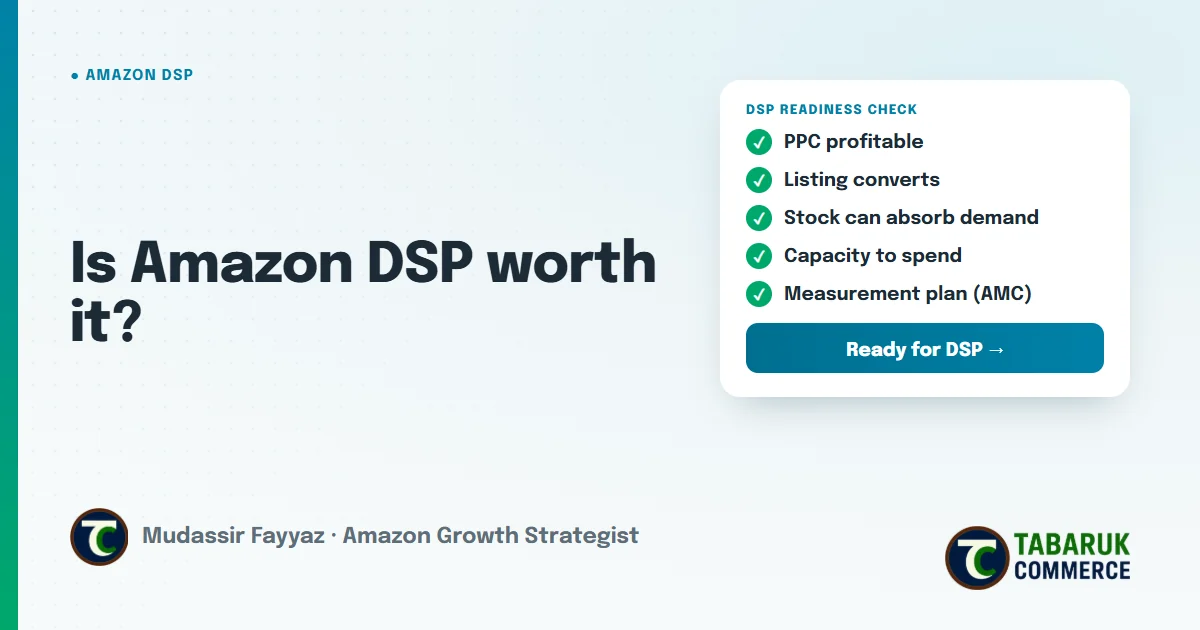
Before recommending DSP, we check five things:
- PPC is mature and profitable. Your Sponsored Ads are structured (branded, non-branded, product targeting, ranking), and you know your break-even ACoS and target TACOS. If PPC isn’t profitable yet, fix that first.
- The listing converts. DSP sends shoppers to your product page. If the page doesn’t convert paid traffic you already have, it won’t convert DSP traffic either.
- Inventory can absorb more demand. Building demand you can’t fulfill is expensive twice: once for the ads, and again for the rank you lose when you stock out.
- There’s capacity to spend. DSP needs enough budget and enough time to show a pattern. A test that’s too small or too short tells you nothing.
- There’s a measurement plan. You’ve decided up front which metrics define success, and you have a way to see the full path to purchase, not just the last click.
If all five are true, DSP is a logical next step for an established brand. If two or three are missing, the money is usually better spent fixing those first.
When Amazon DSP isn’t worth it (yet)
Some situations almost always mean “not now”:
- A brand-new launch with few reviews and an unproven conversion rate. Build the base with Sponsored Ads first.
- Thin margins where even Sponsored Products struggles to stay above break-even.
- Stock problems, like frequent stock-outs or a replenishment cycle you can’t speed up.
- Expecting DSP to fix PPC. If search campaigns are unprofitable, adding another channel adds cost, not clarity.
“Not yet” isn’t “never”. It means the constraint is somewhere else right now, and that’s where the next dollar should go.
How to test Amazon DSP without betting the budget
A good DSP test is designed like any other business decision: a clear question, a defined budget, and a pre-agreed way to judge it.
- Start close to the purchase. Remarketing to shoppers who viewed your products but didn’t buy is the easiest place to see a clear signal. It’s also where you need to check incrementality most carefully. We cover that in detail in our guide to Amazon DSP retargeting.
- Set success metrics per campaign. Retargeting gets efficiency goals. Prospecting gets reach, detail page view and new-to-brand goals.
- Look at the whole path. Amazon Marketing Cloud (AMC) shows how DSP and Sponsored Ads work together before a purchase, which ads new-to-brand customers saw, and how long conversions take.
- Give it a fair window. Upper-funnel impact shows up later than a click. Decide the test length before you start, and don’t judge it halfway through.
- Scale what works, one layer at a time. Once retargeting proves itself, move up to audiences in your category, then broader awareness.
PPC can create momentum, but durability comes from the system underneath it. DSP is how an established brand extends that system beyond search, not how it builds one from scratch.
Amazon DSP FAQs
Is Amazon DSP worth it for small brands?
Usually not as a first step. Smaller brands tend to get more from making Sponsored Ads profitable and improving conversion. DSP makes more sense once PPC is mature, the listing converts well and there’s budget to test properly.
Do you need to sell on Amazon to use Amazon DSP?
No. Amazon DSP is open to advertisers whether or not they sell on Amazon, and ads can drive shoppers to Amazon or to other destinations.
What is the minimum spend for Amazon DSP?
For Amazon’s managed service, Amazon lists a minimum of $50,000 USD, which can vary by country. Self-service access doesn’t follow the same rule, but you still need enough budget to get meaningful results.
Is Amazon DSP better than Sponsored Display?
They overlap, but DSP gives you more control over audiences, frequency and inventory, including placements off Amazon. Sponsored Display is simpler and runs inside the Amazon Ads console. Many brands start with Sponsored Display and move to DSP as they grow.
How do you measure Amazon DSP success?
Match the metric to the campaign’s job. Retargeting can be judged on efficiency. Prospecting and awareness should be judged on reach, detail page views, new-to-brand customers and branded search growth, ideally with AMC showing the full path to purchase.
Thinking about DSP?
We manage Amazon DSP for established brands as the next stage after PPC management, with measurement set up before the first dollar is spent. If you’re not sure your brand is ready, request a free Amazon account audit and we’ll tell you honestly whether DSP or something else should come first.

Mudassir Fayyaz is the founder of Tabaruk Commerce and an Amazon growth strategist. He manages 1P and 3P Amazon accounts across the US, Canada, UK, Germany, UAE, and Australia, with a focus on turning ad spend into net profit. Connect on LinkedIn.