Diagnose the constraint. Allocate resources. Measure the impact. Then scale what works.
Mudassir Fayyaz, Founder, Tabaruk Commerce
Most Amazon product research starts and ends with a tool score. Pick a niche, filter for high revenue and low reviews, see a green number, and order inventory.
That shortcut is why so many products launch into markets they can’t win. A tool can tell you that demand exists. It can’t tell you whether you can take a profitable share of it, or why a shopper would pick your product over the ten already ranking.
This guide walks through the Amazon product research process we use, from idea to competitive edge: where ideas come from, how to validate them, how to find a real point of difference, and how to map the competitors you’ll actually face.
Key takeaways
- A good tool score is a starting point, not a decision.
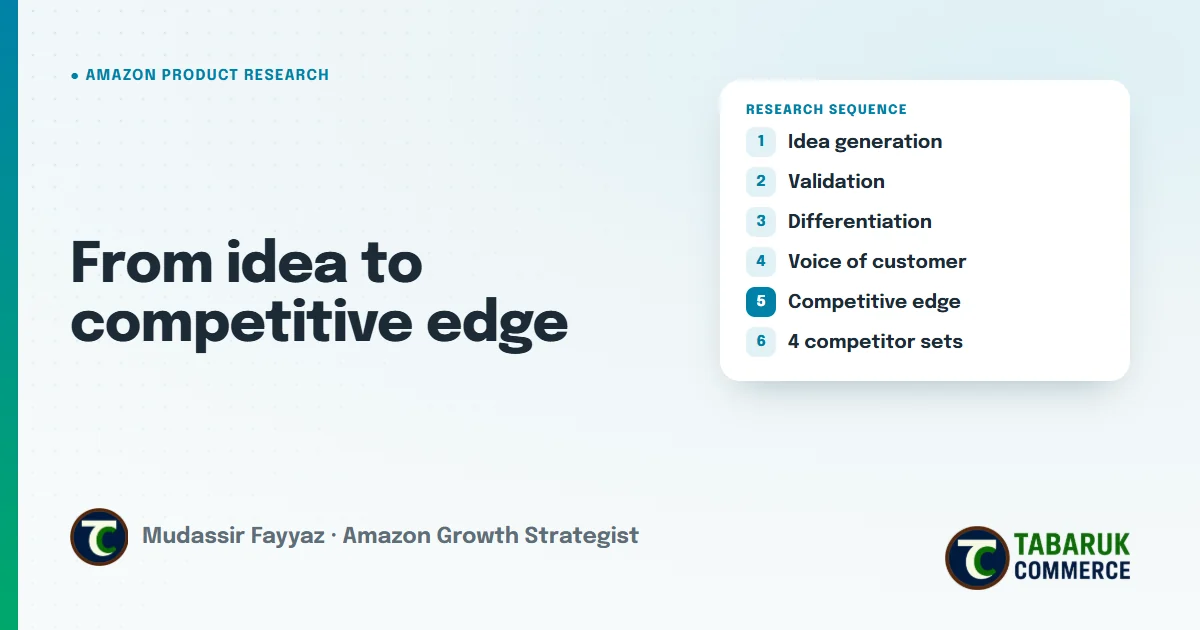
- Research runs in order: idea generation, validation, differentiation, voice of customer, competitive edge.
- Validation means checking demand quality and margin after fees and advertising, not just search volume.
- Reviews of competing products are the best source of differentiation ideas.
- Map four competitor sets before you launch, so you know who you’re really up against.
Why a tool score isn’t Amazon product research
Research tools are useful. We use them every day. The problem is treating their output as the answer.
A high “opportunity score” usually combines things like demand, revenue and review counts. What it doesn’t include is your cost of goods, your advertising cost to reach page one, how hard it is to stand out, or whether the demand is spread across dozens of sellers or held by two brands.
The hidden cost of more SKUs is starving the few products that could have compounded. Every weak product you launch takes budget, inventory and attention from the ones that could grow. Good product research is as much about what you don’t launch as what you do.
Step 1: Idea generation, casting a wide net
Good ideas rarely come from one place. We pull candidates from several sources, then narrow them down:
- Product Opportunity Explorer: Amazon’s own tool in Seller Central (under Growth). It groups products into customer niches and shows search volume, units sold and trends from Amazon’s data.
- Best Sellers and New Releases: what’s selling now, and what’s gaining traction quickly in a category.
- Helium 10 Black Box: filtering products by demand, price, reviews and other criteria to surface candidates at scale.
- Minus-string searches: typing a minus sign followed by random letters (for example
-jhghilgkyugugb) into Amazon search, often inside a category. Because the random string matches nothing, Amazon shows products it would normally rank, and the high-selling ones rise to the top. It’s a quick way to see what actually sells in a category, beyond the keywords you already know. - Your own ideas: the brand’s existing customers, adjacent products and supplier capabilities are often the most defensible starting points.
At this stage, quantity is fine. The next steps are designed to cut the list hard.
Step 2: Validation, is the demand real and is it profitable?
Validation answers two questions: is there real, lasting demand, and can you make money serving it?
Demand quality. Search volume measures opportunity size. It doesn’t measure opportunity quality. We look at whether demand is steady or seasonal, whether it’s growing or fading, how many different products share the sales, and whether the searches are specific enough to convert. Demand checks come before any conversation about suppliers or samples.
Margin after everything. A product only works if it’s profitable after product cost, shipping, referral fees, FBA fees, storage and advertising. That last one is where most research falls down. If you need to spend heavily on PPC to rank, that cost belongs in the model from day one. Our guide to break-even ACoS shows how to calculate how much ad spend a product can actually carry.
If an idea fails either test, it’s out, no matter how good the tool score looked.
Step 3: Differentiation, why would anyone switch?
A validated niche still doesn’t mean your product will win. The question now is simple: why would a shopper pick yours?
Differentiation doesn’t have to mean a new invention. It can be a better size, a missing feature, a more useful bundle, better materials, clearer instructions or packaging that solves a real annoyance. What matters is that the difference is something shoppers care about and can see in a few seconds on a search results page.
A “better” product that looks the same as everyone else in the main image and title will compete on price. That’s rarely a fight worth starting.
Step 4: Voice of customer, let the reviews tell you
The best differentiation ideas are already written down, in competitors’ reviews.
We read the reviews of the top products in the niche, especially the three- and four-star ones, where buyers explain what almost worked. We group the complaints and praise into themes: quality, size, durability, ease of use, missing parts, what the product was used for.
Voice of customer (VOC) does two jobs. It tells you what to change in the product, and it gives you the language to use in your listing later. If shoppers keep saying “finally one that doesn’t leak”, that phrase belongs in your title, bullets and images.
Step 5: Competitive edge and the four competitor sets
Before launch, we map the competitors you’ll actually face. Not one list, but four:
- SERP set: the products showing up for your main searches. This is who shoppers compare you with.
- Displacement set: three to six products you can realistically beat on page one. These are your first targets.
- Benchmark set: the category leaders. You study them to understand what “good” looks like, not to beat them on day one.
- Whitespace set: products and angles showing where the market is moving next.
This map turns into your launch plan: which keywords to target first, which products to target with ads, what price position to take and what your listing must prove better than the displacement set.
Common Amazon product research mistakes
- Falling for the headline number. A big category revenue figure says nothing about the share you can take.
- Leaving advertising out of the margin. Almost every new product needs PPC to get going. If the model ignores it, the model is wrong.
- Copying the best seller. Launching the same product with a different logo puts you in a price war with a brand that has more reviews and more history.
- Skipping the reviews. Competitors’ reviews are free research. Ignoring them means guessing at what buyers want.
- Ignoring seasonality. A niche that looks strong in its peak month can be quiet for the rest of the year.
- Researching alone. Supplier capability, cash flow and lead times decide what’s realistic. Research that ignores them produces ideas you can’t execute.
None of these mistakes show up in a tool score. They show up later, in unsold stock and ad spend that never pays back.
What good product research leaves you with
At the end of the process, you shouldn’t just have “a product”. You should have:
- A validated niche with demand that’s real and lasting.
- A margin model that includes fees and advertising.
- A clear point of difference based on what customers actually say.
- A competitor map and a first set of keywords and products to target.
That’s what makes a launch a plan instead of a bet.
Amazon product research FAQs
What is the best Amazon product research tool?
There isn’t one best tool. Amazon’s Product Opportunity Explorer shows demand from Amazon’s own data, and tools like Helium 10 help filter and compare products at scale. The tools find candidates. The decision still depends on margin, differentiation and competition.
How do you know if a product will sell on Amazon?
You can’t know for certain, but you can reduce the risk. Check that demand is steady and specific, that the margin works after fees and advertising, that you have a clear point of difference, and that there are competitors on page one you can realistically beat.
Is Product Opportunity Explorer free?
It’s available inside Seller Central under the Growth menu at no extra cost for sellers who have access to it.
How long should Amazon product research take?
Long enough to validate demand, margin and competition properly. Rushing research is usually far more expensive than taking the time, because the cost of a wrong product shows up later as unsold inventory and ad spend.
Why do reviews matter in product research?
Competitors’ reviews show what buyers like and what disappoints them. They’re the most direct source of ideas for product improvements and for the language to use in your listing.
Want a second opinion before you order inventory?
Our product research and validation service takes ideas from generation to a validated, differentiated product with a competitor map and margin model. If you already have products on Amazon, request a free Amazon account audit to see where your portfolio stands.

Mudassir Fayyaz is the founder of Tabaruk Commerce and an Amazon growth strategist. He manages 1P and 3P Amazon accounts across the US, Canada, UK, Germany, UAE, and Australia, with a focus on turning ad spend into net profit. Connect on LinkedIn.