
“Remove the hijacker” sounds like the objective. Protecting the business is the objective.
Mudassir Fayyaz, Founder, Tabaruk Commerce
An Amazon related account suspension is one of the most confusing notices a seller can get. Your own account may have good metrics and no policy problems. Then one message says it’s been deactivated because it’s related to another account, and that’s often all the detail Amazon gives.
The natural reaction is to appeal immediately and say “I don’t know that account.” That’s also the most common mistake. An appeal that doesn’t explain what Amazon found, or why it isn’t a risk, rarely works, and every weak submission makes the next one harder.
This guide explains what a related account suspension is, what Amazon may have linked, how to build an appeal that answers the question Amazon is actually asking, and what to avoid while your account is deactivated.
Key takeaways
- A related account suspension means Amazon connected your account to another account that has a problem.
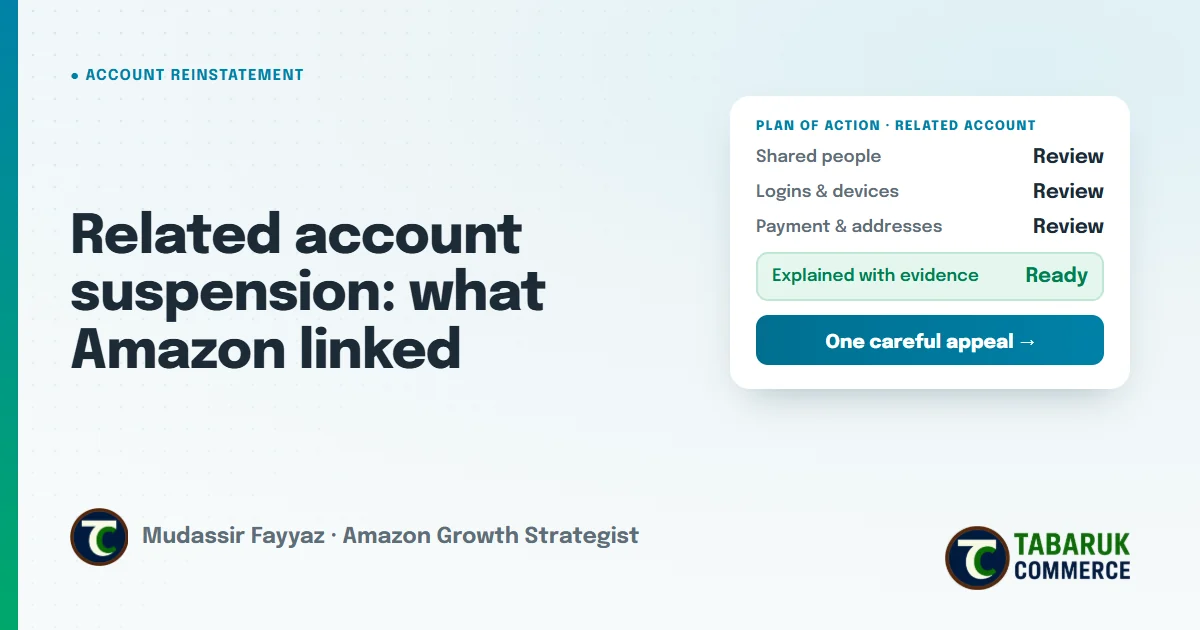
- The link usually comes from shared information: people, devices, logins, payment details or addresses.
- Your appeal has to explain the relationship honestly, with evidence, not just deny it.
- If the other account really is related, its issue may need to be resolved first.
- Don’t rush repeated appeals, and don’t trust anyone promising a guaranteed or “insider” reinstatement.
What is an Amazon related account suspension?
Amazon deactivates accounts it believes are connected to another account that’s been deactivated, or connected in a way that breaks its rules on operating multiple accounts. The deactivation isn’t necessarily about anything your account did. It’s about who, or what, your account is connected to.
That’s why this type of suspension feels unfair, and also why it needs a different kind of appeal. You’re not explaining a performance problem. You’re explaining a relationship.
It’s also different from other suspensions. Performance, intellectual property and product policy suspensions have their own causes and their own kind of plan of action. This article covers related-account cases only.
What can link one Amazon account to another?
Amazon doesn’t usually tell you exactly which signal it found. In practice, accounts become connected through shared information such as:
- People: the same owner, director, family member or employee involved in more than one account.
- Logins and devices: the same computer, browser, phone or network used to access different accounts.
- Payment details: a shared bank account, credit card or payment method.
- Addresses: the same business, return or warehouse address.
- Service providers: a virtual assistant, agency or freelancer who logged into several sellers’ accounts, or a third-party tool with account access.
- Business information: overlapping company details, contact details or tax information.
Some of these connections are completely legitimate. A family business can have more than one account for good reasons. An agency can manage many clients. The goal isn’t to hide the connection. It’s to understand it, and explain it clearly.
Step 1: Find the relationship before you write anything
A related account suspension isn’t the problem to solve. It’s the evidence that Amazon found a connection. Your first job is to find out what that connection probably is.
- List every account you’ve ever been connected to, on any Amazon marketplace, including old or closed ones.
- List everyone with access to your account: team members, assistants, agencies, freelancers and tools.
- Check shared details: bank accounts, cards, addresses, devices and networks used to log in.
- Check the other account’s status, if you know which one it is. If it has an open issue, that’s usually where the real problem is.
Only when you know the likely link can you decide what the appeal needs to say.
Step 2: Decide which situation you’re in
Most related account cases fall into one of three situations. Each needs a different appeal.
The accounts really are related, and the other account has a problem
In this situation, the issue on the other account usually has to be addressed first. If that account was deactivated for its own reasons, fixing those reasons, or clearly separating from that account, is often the only realistic path back.
The accounts are related, but the relationship is legitimate
Explain the relationship honestly: who is connected, how, and why each account exists. Show that each account is operated properly and doesn’t exist to get around a restriction or a previous deactivation.
You don’t believe the accounts are related at all
Then your appeal needs evidence, not just a denial. Show your business documents, ownership, bank details and addresses, and explain any shared service provider or tool that might have created an accidental link.
Step 3: Build the plan of action
An Amazon plan of action is your written response to the deactivation. For a related account case, it should cover three things clearly and briefly:
- Root cause: what connected the accounts, as far as you can establish it.
- Corrective actions: what you’ve already done. For example, removing a third party’s access, separating payment details, or resolving the issue on the other account.
- Preventive measures: what’s changed so it doesn’t happen again. For example, who can access the account, how logins are managed, and how you’ll vet service providers.
Attach documents that support what you say. Keep the tone factual. Don’t blame Amazon, don’t write long emotional explanations, and never submit anything that isn’t true or documents that have been edited. That turns a solvable case into one that isn’t.
You submit the appeal from the Account Health page in Seller Central, where Amazon shows the option to reactivate your account and what it needs from you.
What not to do during a related account suspension
- Don’t send rushed or repeated appeals. Each weak submission can make the next one harder. One careful, complete appeal beats five fast ones.
- Don’t open a new account to keep selling. It creates exactly the kind of connection that caused the problem.
- Don’t try to hide connections with tricks around devices, networks or details. The goal is a legitimate explanation, not concealment.
- Don’t trust guarantees. Be very careful with anyone who promises reinstatement through “insiders”, secret contacts or special tricks. Amazon makes the final decision, and no honest provider can promise the outcome.
After reinstatement: protect the account
Getting reactivated is the start, not the finish. Review who has access to the account, remove anyone who no longer needs it, use separate logins for every user, keep business and payment details consistent, and check Account Health regularly. Reinstatement matters, but preventing the next deactivation matters more.
Amazon related account suspension FAQs
What does “related account” mean on Amazon?
It means Amazon has connected your account to another seller account, usually through shared people, devices, logins, payment details or addresses, and that other account has an issue.
Can I get my account back if it’s related to a suspended account?
Sometimes. If the accounts really are related, the other account’s issue may need to be resolved first. If the relationship is legitimate or there’s no real relationship, you need a clear appeal with supporting evidence. Amazon makes the final decision.
What should a related account appeal include?
A clear explanation of the relationship or the lack of one, the corrective actions you’ve taken, the preventive measures you’ve put in place, and documents that support each point.
Should I appeal again if my first appeal is rejected?
Not immediately. Work out why it didn’t answer Amazon’s concern, strengthen the explanation and evidence, and then submit. Repeated weak appeals make the case harder.
Can someone guarantee my account reinstatement?
No. Amazon makes the final decision. Be careful with any service that promises guaranteed reinstatement or claims special access inside Amazon.
Need an honest review of your case?
We handle related-account and verification cases in our Amazon account suspension and reinstatement service. We start with an honest case review and tell you whether the case looks appealable before any work begins. For broader account protection, see our brand health and account support, or request a free Amazon account audit.

Mudassir Fayyaz is the founder of Tabaruk Commerce and an Amazon growth strategist. He manages 1P and 3P Amazon accounts across the US, Canada, UK, Germany, UAE, and Australia, with a focus on turning ad spend into net profit. Connect on LinkedIn.