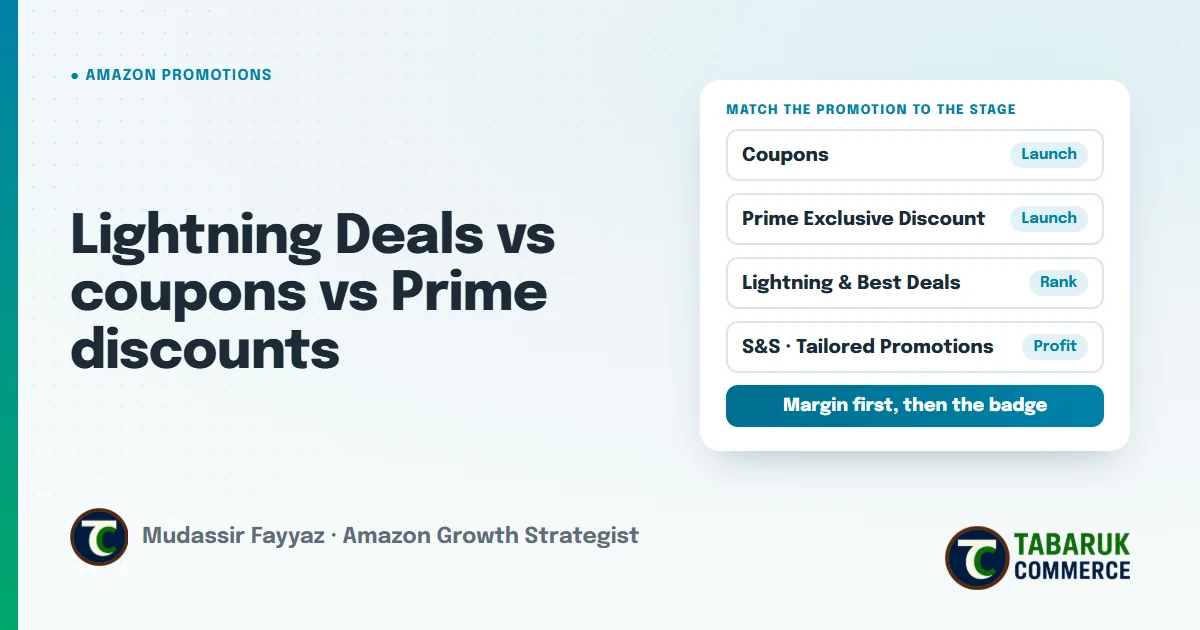
A discount is ad spend paid from your margin. It deserves the same break-even math as PPC.
Mudassir Fayyaz, Founder, Tabaruk Commerce
“Should we run a Lightning Deal or a coupon?” sounds like a tactical question. It’s actually a strategy question, and most brands answer it the wrong way round.
Amazon Lightning Deals, Best Deals, coupons and Prime Exclusive Discounts all lower the price. But they reach different shoppers, show up in different places, cost different amounts and do different jobs. Picking one because it’s the one you used last time, or because a competitor is running it, is how promotions end up giving away margin without building anything.
This guide explains what each promotion does, when each one fits, and the checks every promotion should pass before it goes live.
Key takeaways
- A discount is ad spend paid from your margin. It needs the same break-even math as PPC.
- Lightning Deals and Best Deals are for selective pushes. Coupons and Prime Exclusive Discounts suit launch and steady support.
- The product’s stage (Launch, Rank or Profit) decides which promotion fits.
- Promotions can combine at checkout. Check for stacking before anything goes live.
- Sometimes the most profitable promotion is the one you don’t run.
The four promotions, side by side
Lightning Deals
A Lightning Deal is a short, time-limited deal with a set number of discounted units. It runs for a matter of hours, shows a countdown and a progress bar of units claimed, and can appear on Amazon’s Deals page. It creates urgency and a concentrated burst of sales in a short window.
That burst is the point, and also the risk. If the listing doesn’t convert or the stock plan is thin, a Lightning Deal concentrates the problem into a few hours.
Best Deals
A Best Deal runs longer than a Lightning Deal, for up to about two weeks, without a fixed unit count or a countdown. It gives a steadier lift over a longer period and suits products that need sustained sales velocity rather than a single spike.
Coupons
A coupon is a clippable discount, either a percentage or a fixed amount, that shows as a badge in search results and on the product page. Shoppers clip it and the discount applies at checkout. Coupons are flexible: you control the budget, the dates and, to a degree, the audience.
The coupon badge is visible right in search results, so it can help click-through. That makes it useful when you need more shoppers to notice the product, not just a lower price once they’re already on the page.
Prime Exclusive Discounts
A Prime Exclusive Discount (PED) is a price discount only Prime members see. It shows as a strike-through price with a Prime badge, and applies automatically without a clip. Amazon now manages these through the Price Discounts tool in Seller Central, and they need a real saving against your recent price to qualify.
PEDs are a good fit when your buyers are mostly Prime members and you want a clean, automatic discount without the extra step of clipping a coupon.
What each promotion costs
Every promotion has two costs: the discount itself, and Amazon’s fee for running it.
- Deals (Lightning Deals, Best Deals and, during major events, Prime Exclusive Discounts) are charged an upfront fee per deal plus a percentage of the sales made during the promotion. Fees are higher around tent-pole events like Prime Day and Black Friday than in the rest of the year.
- Coupons are charged a fee per coupon plus a percentage of the sales made with the coupon.
Amazon has changed these fee structures more than once since 2025, so check the current rates in Seller Central before you plan. The exact numbers matter less than the principle: the fee, the discount and any extra ad spend all come out of the same unit margin.
If you haven’t worked out your break-even point, start there. Our guide to break-even ACoS explains how to calculate it from your margin, referral fee, FBA fees and storage.
Which promotion to use: match it to the product stage
The right promotion depends less on the promotion and more on the product. Every product is in one of three stages, and each stage has a different goal.
Launch: velocity
A new product needs first sales, first reviews and early ranking signals. Coupons and Prime Exclusive Discounts work well here because they’re flexible, run for longer and help the product get noticed in search. Social media promo codes can bring in external traffic, tracked with Amazon Attribution.
A Lightning Deal is rarely the right first move for a new product. Deals usually need an established rating and price history to qualify, and a short spike doesn’t build much if the listing is still unproven.
Rank: selective pushes
Once a product converts and has stock, the goal is to lift organic position on high-intent keywords. This is where Lightning Deals and Best Deals earn their place: timed with tent-pole events, backed by a planned PPC push during the deal window, and chosen for the products that can hold the rank afterwards.
Profit: retention
A mature product doesn’t need a discount to be seen. It needs repeat customers at a lower acquisition cost. Here the better tools are Subscribe & Save, for consumables and repeat-purchase products, and Brand Tailored Promotions, which send discounts only to chosen audiences such as cart abandoners, repeat buyers and brand followers.
A launch-stage discount on a mature product gives margin away for nothing. The stage decides the tool.
The checks every promotion should pass first
Before any promotion goes live, it goes through the same six checks, in this order. We call it the Promotion Decision Sequence.
- Margin. Does the unit stay above break-even after the discount, the fees and any extra ad spend?
- Conversion. Does the listing already convert? A deal sends more traffic to the same page.
- Inventory. Can stock absorb the spike and cover the weeks after it?
- Eligibility. Do the rating and recent price history qualify for this promotion?
- Stage. Is the product in Launch, Rank or Profit?
- Measure. How will you know if it worked: incremental sales, new customers and the sales baseline after it ends?
A deal doesn’t fix a listing. It sends more buyers to find out it’s broken, faster.
The stacking problem
Amazon can combine some promotions on the same product. A coupon, a Prime Exclusive Discount and a deal running at the same time can add up to a price much lower than any of them was planned to be.
Stacking isn’t always obvious from inside Seller Central, especially when different people or tools manage different promotions. Before launch, list every active promotion on each ASIN and check the lowest possible price a shopper could pay. If you wouldn’t approve that price on purpose, fix it before it goes live.
Stacking has a second cost too. A price that drops too low can lower the reference price Amazon uses to judge future deals, which can make your next deal harder to qualify for.
When not to run a promotion at all
Sometimes the most profitable promotion is the one you don’t run. Hold off when:
- The margin is below break-even once the discount, fees and ad spend are added.
- The listing doesn’t convert. Fix the main image, title, bullets and A+ Content first.
- Stock can’t handle it. Under 30 days of cover gets a purchase order, not a deal.
- It would stack or damage the price and hurt future deal eligibility.
Amazon Lightning Deals and coupons FAQs
What is the difference between a Lightning Deal and a coupon?
A Lightning Deal is a short, time-limited deal with a set number of units and a countdown. A coupon is a clippable discount that can run for longer and shows as a badge in search results.
Are Amazon Lightning Deals worth it?
They can be, for products that already convert, have enough stock and have healthy margin after fees. They’re a selective push for the rank stage, not a fix for a weak listing.
What is a Prime Exclusive Discount?
A price discount only Prime members see. It shows as a strike-through price with a Prime badge and applies automatically at checkout, without clipping.
Can I run a coupon and a deal at the same time?
Some promotions can combine at checkout. Always check every active promotion on the ASIN before launch, so the final price is one you actually approved.
Which promotion is best for a new product?
Usually coupons or Prime Exclusive Discounts, because they’re flexible and help a new product get noticed. Deals tend to work better once a product has ratings, price history and proven conversion.
Not sure which promotion fits your products?
We plan deals, coupons, Prime Exclusive Discounts, Brand Tailored Promotions and Subscribe & Save against your margin, stock and product stage in our Amazon promotions and deals management service. To see which products are ready for a promotion and which need something else first, request a free Amazon account audit.

Mudassir Fayyaz is the founder of Tabaruk Commerce and an Amazon growth strategist. He manages 1P and 3P Amazon accounts across the US, Canada, UK, Germany, UAE, and Australia, with a focus on turning ad spend into net profit. Connect on LinkedIn.