Prime Day is won in the eight weeks before it and kept in the three weeks after it.
Mudassir Fayyaz, Founder, Tabaruk Commerce
Most brands start thinking about Prime Day about two weeks before it. They submit a few deals, raise budgets on the morning of the event and hope the traffic turns into profit. Then the event ends, sales fall back, and nobody can say whether it was worth it.
A good Amazon Prime Day strategy doesn’t start with the deal. It starts eight weeks earlier, with stock, margin and conversion, and it doesn’t finish until two to three weeks after the event, when you find out whether the rank and the new customers stayed.
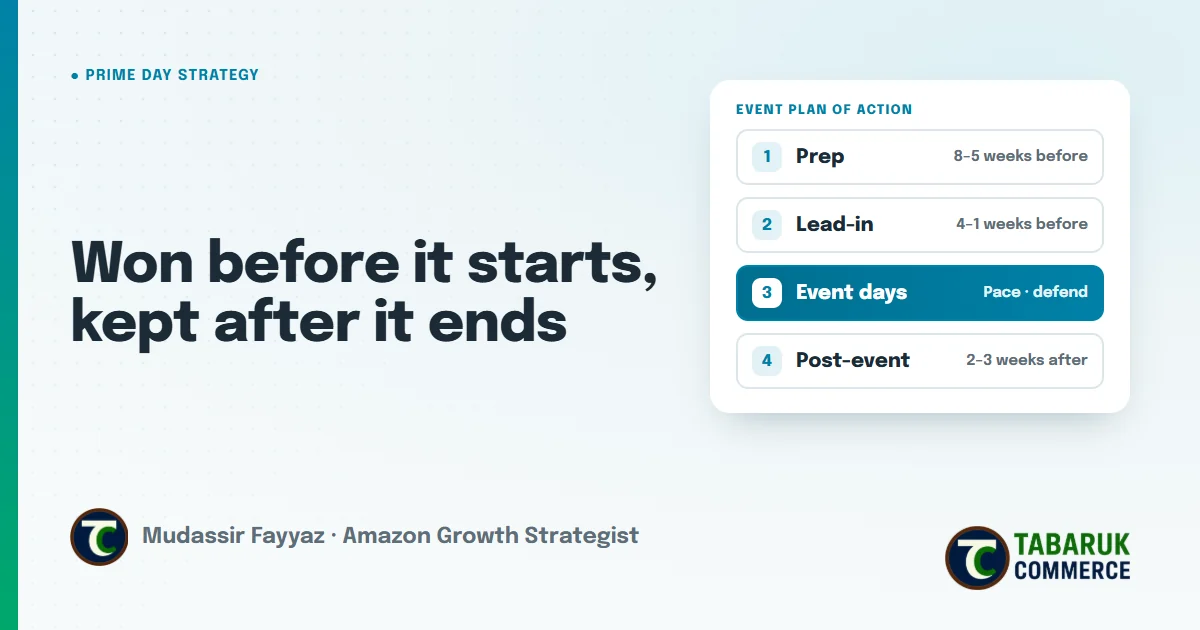
This guide walks through the four-phase Event Plan of Action we use for Prime Day. The same plan works for Prime Big Deal Days and Black Friday / Cyber Monday.
Key takeaways
- Prime Day is two days. The plan behind it is about eight weeks before and two to three weeks after.
- Deal submissions and inventory deadlines close weeks before the event, so planning late means planning with fewer options.
- Not every ASIN deserves a deal. Margin, conversion and stock decide which products go in.
- During the event, pace budgets and protect branded search. Cut what loses money the same day.
- Judge the event by the baseline after it ends, not by the spike on deal day.
Why most Prime Day plans start too late
Amazon sets deadlines for tent-pole events well in advance. Deal submission windows for major events open and close weeks before the event, and inventory has to be checked in at Amazon by a set date to be eligible. For the 2026 holiday events, for example, Amazon opened deal submissions in early July and set separate inventory arrival windows ahead of each event.
If your planning starts two weeks out, most of the important decisions have already been made for you. The stock you have is the stock you get. The deals you didn’t submit won’t run. The listing issues you didn’t fix will meet the biggest traffic of the quarter.
A late plan isn’t a smaller version of a good plan. It’s a different outcome.
The Event Plan of Action: four phases over about eight weeks
Every big event gets a written Event Plan of Action with dates, the ASIN list, budgets and stock targets. It has four phases.
Phase 1: Prep (8 to 5 weeks before)
This is where most of the result is decided.
- Stock and inbound deadline. Forecast demand for the event plus the two to four weeks after it, and plan shipments so stock is checked in before Amazon’s cut-off. A deal that sells out on day one hands your rank to a competitor.
- Deal selection. Put every ASIN through the 5-Bucket Portfolio Framework. Winners with stock and healthy margin get a deal. Margin-negative, low-stock or poorly converting products don’t.
- Listing and price prep. Fix conversion problems first: main image, title, bullets, A+ Content. Keep the price stable in the weeks before, because deal eligibility depends on your recent price history. A price you raised last month can make the deal look like a fake saving, or make it ineligible.
- Stacking check. Review every coupon, Prime Exclusive Discount and deal on the same ASIN, so the final price at checkout is one you actually approved.
Phase 2: Lead-in (4 to 1 weeks before)
Shoppers don’t decide what to buy on Prime Day morning. Many of them are browsing, adding to cart and comparing in the weeks before.
- Build demand before the event. Sponsored Brands and Sponsored Display build awareness and fill retargeting audiences. For established brands with the budget for it, DSP adds upper-funnel reach, so interest already exists when the deal badge goes live.
- Campaign structure ready. Event campaigns, budgets and bid rules are built and checked in advance, not on the morning of the event.
Phase 3: Event days
The event itself is about control, not creativity. The plan is already written. The job is to run it and react to what the data shows.
- Budget and bid pacing. Raise bids and budgets on high-intent keywords, and check pacing through the day so your best campaigns don’t run out of budget by midday.
- Live monitoring. Watch the Featured Offer (Buy Box), stock levels, suppressions, hijackers and competitor prices while the event runs.
- Protect branded terms. Competitors will bid on your brand name when traffic is highest. Defend branded search and your own product pages.
- Cut what isn’t working. Keywords and ASINs that lose money during the event are paused or pulled back the same day, not reviewed next week.
Phase 4: Post-event (2 to 3 weeks after)
This is the phase most brands skip, and it’s where most of the value is kept or lost.
- Retarget event traffic. Shoppers who viewed or added to cart but didn’t buy are retargeted with Sponsored Display, Brand Tailored Promotions and, where it fits, DSP.
- Gradual ramp-down. Bring bids and budgets back to normal over several days, not overnight. A sudden cut can undo the rank the event built.
- Baseline and halo review. Compare sales, organic rank and share of search against the weeks before the event. Measure new-to-brand customers and the halo on products that weren’t on deal.
- Restock and lessons log. Restock the winners quickly, and write down what worked and what didn’t for the next Event Plan of Action.
How to choose which ASINs get a Prime Day deal
The question isn’t “which products can we discount?” It’s “which products can take a discount and still make the business stronger?”
Before any ASIN goes into the deal list, it has to pass four checks:
- Margin. After the discount, the deal fees and the extra ad spend, is the unit still above break-even? If you haven’t calculated it, start with your break-even ACoS.
- Conversion. Does the listing already convert well outside the event? A deal multiplies traffic. It doesn’t fix a page that loses buyers.
- Inventory. Can stock cover the event and the weeks after it? A product with thin cover gets a purchase order, not a deal.
- Eligibility. Do the rating and recent price history meet Amazon’s deal requirements?
A product that fails one of these checks isn’t a Prime Day product this year. That’s not a missed opportunity. It’s a protected margin.
Prime Day and PPC: one budget, not two
The discount and the ad spend are both costs of winning a customer. Treating them as two separate budgets makes each one look fine on its own while the combined cost quietly eats the margin.
We count them together, as one acquisition cost against target TACOS. Within that combined budget, PPC gets pushed during the deal window, because conversion rate usually rises while a deal badge is showing. When the deal ends, spend comes down gradually. For how we structure campaigns around events, see our Amazon PPC management approach.
How to measure whether Prime Day was worth it
Revenue on deal day tells you almost nothing on its own. A deal can produce a big spike and still leave the business worse off. We look at four things:
- Incremental vs pulled-forward sales. Did the event create new demand, or did it move sales that would have happened anyway to a lower price?
- Post-event baseline. Did organic rank and daily sales settle higher than before the event, or fall back?
- New-to-brand and repeat customers. How many new customers came in, and do they come back?
- Profit after promotion cost. Net profit after the discount, deal fees, coupon costs and extra ad spend.
The spike isn’t the result. The baseline after the deal ends is the result.
Amazon Prime Day strategy FAQs
How early should I start planning for Prime Day?
About eight weeks before the event. Deal submissions and inventory deadlines close weeks in advance, and stock has to be checked in at Amazon before the cut-off to be eligible.
Should every product get a Prime Day deal?
No. Only products with healthy margin, good conversion, enough stock and a clean price history should get a deal. The rest are better left out of the event.
Should I increase PPC budgets during Prime Day?
Yes, on high-intent keywords and within a combined budget that includes the discount cost. Check pacing through the day so your best campaigns don’t run out of budget early.
What should I do after Prime Day ends?
Retarget shoppers who viewed or added to cart, bring budgets down gradually, restock the winners and compare rank and sales to where they were before the event.
Does the same plan work for Prime Big Deal Days and Black Friday?
Yes. The four phases are the same for any tent-pole event. Only the dates and Amazon’s deadlines change.
Want a written Event Plan of Action for your next event?
We build the full pre, during and post plan for Prime Day, Prime Big Deal Days and BFCM in our Amazon promotions and deals management service. If you’d like to know which of your products are ready for a deal, request a free Amazon account audit.

Mudassir Fayyaz is the founder of Tabaruk Commerce and an Amazon growth strategist. He manages 1P and 3P Amazon accounts across the US, Canada, UK, Germany, UAE, and Australia, with a focus on turning ad spend into net profit. Connect on LinkedIn.