Constraint-based growth is a ranking system for where capital, attention, and execution should go first.
Mudassir Fayyaz, Founder, Tabaruk Commerce
Every FBA unit you send with an Amazon barcode sticker carries a cost: the label, the time to apply it, and the risk of getting it wrong.
For years, many brand owners accepted that cost to protect themselves from commingling. In 2026, that trade-off changed. Amazon ended commingling on March 31, 2026, and it stopped offering its own FBA prep and labeling service in the US on January 1, 2026.
If you own your brand, going from stickered to stickerless is now one of the simplest FBA cost savings available, and the old reason not to do it is gone.
Key takeaways
- Stickerless means sending FBA inventory using the manufacturer barcode (UPC, EAN or GTIN) instead of an Amazon FNSKU label.
- Amazon ended commingling on March 31, 2026. Stickerless units from brand owners are no longer pooled with other sellers’ stock.
- Brand owners in Brand Registry can use manufacturer barcodes. Resellers now have to label every unit.
- Amazon stopped offering FBA labeling in the US on January 1, 2026, so every sticker is now your own labor or a prep center fee.
FNSKU vs manufacturer barcode: what’s the difference?
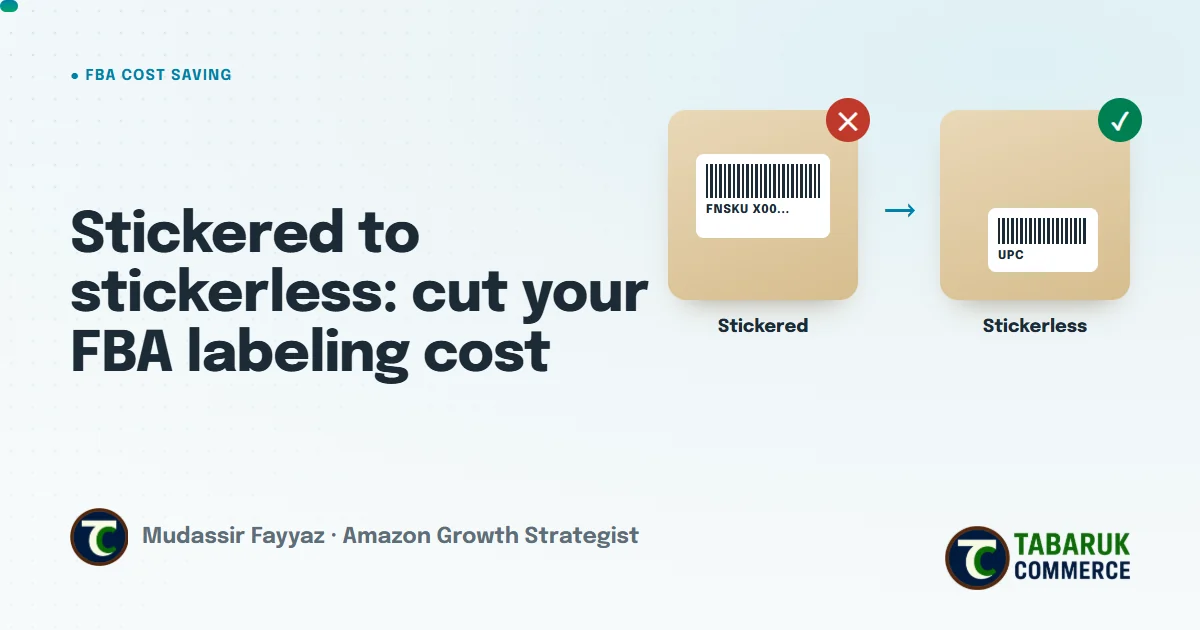
An FNSKU is Amazon’s own barcode. It links a unit to your seller account, so Amazon knows exactly whose inventory it is. It usually means printing a label and sticking it over the product’s existing barcode.
A manufacturer barcode is the UPC, EAN or GTIN already printed on your product packaging. Sending “stickerless” means Amazon scans that barcode instead, with no extra label.
The reason brand owners used to avoid stickerless was commingling. Under the old system, stickerless units could be pooled with identical products from other sellers, and Amazon could ship a customer someone else’s unit. If another seller sent counterfeit, damaged or expired stock, your brand could take the complaint.
What changed in 2026
Two changes, three months apart, reshaped the economics.
- January 1, 2026: Amazon stopped offering FBA prep and item labeling services in the US. If units need an FNSKU, you or your prep center apply it.
- March 31, 2026: Amazon ended commingling. Brand owners enrolled in Amazon Brand Registry with the Brand Representative role can keep using manufacturer barcodes without Amazon stickers, and that inventory is attributed to their own account rather than pooled. Resellers are now required to use Amazon barcode stickers, even when the product already has a manufacturer barcode.
Put simply: labeling got more expensive for everyone, and stickerless got safer for brand owners.
Why stickerless saves brand owners money
The savings go beyond the label itself.
- No per-unit labeling cost. No labels to buy and print, and no labor or prep center fees to apply them.
- Faster inbound. Units can go from your manufacturer or warehouse to Amazon with less handling, which shortens the gap between production and sellable stock.
- Fewer labeling errors. A wrong or unreadable sticker can mean receiving problems, mismatched inventory or units that aren’t available to sell. Fewer labels means fewer mistakes to pay for.
- More flexible inventory. Units without an Amazon sticker can go to other channels too, like your own website or retail, without relabeling. Amazon noted this flexibility itself: brands no longer need to pre-allocate units across channels.
A simple way to size your savings
Every account is different, so here’s a clearly hypothetical example to show the math. Replace the numbers with your own.
Hypothetical example
A brand sends 20,000 FBA units a year. Its all-in cost to label each unit (label, printing and prep center handling) is $0.30.
20,000 units × $0.30 = $6,000 a year in labeling alone, before counting the time units spend waiting to be labeled, or the cost of fixing labeling mistakes.
For a small catalog, that may not change your year. For a brand shipping tens of thousands of units, it’s real margin, and it compounds as you grow.
How to switch from stickered to stickerless
This is the process we follow when we move client brands to stickerless:
- Confirm Brand Registry and your role. Stickerless without commingling is for brand owners enrolled in Brand Registry with the Brand Representative role. Check this first.
- Audit your barcodes. Every product needs a scannable manufacturer barcode on its packaging that matches the correct listing. One barcode per unit. If a product has no manufacturer barcode, it still needs an FNSKU.
- Check your barcode preference in Seller Central. Set your FBA barcode preference to manufacturer barcodes for the eligible SKUs, and confirm each SKU shows the barcode type you expect before you ship.
- Coordinate with your supplier and prep center. Make sure packaging barcodes are printed clearly, and that no one keeps applying FNSKU labels out of habit.
- Start with one shipment. Send a smaller shipment first, confirm it’s received correctly, then roll it out across the catalog.
- Keep FNSKU where it still makes sense. Products without manufacturer barcodes, bundles and some special cases still need Amazon labels.
What if you’re a reseller?
If you resell other brands’ products and aren’t the brand’s representative in Brand Registry, the rules now point the other way: every unit needs an Amazon barcode sticker, even if it already has a manufacturer barcode. Inventory that arrives without proper labeling risks being flagged, delayed or blocked from sale.
To keep the cost down, build labeling into your landed cost per unit, batch labeling at your prep center, and check label quality before shipments leave. The cost hasn’t gone away, so price it in instead of absorbing it.
Stickerless FBA FAQs
Did Amazon end commingling?
Yes. Amazon ended commingling on March 31, 2026. Inventory is no longer pooled between sellers.
Can I still send stickerless inventory to FBA?
Brand owners enrolled in Brand Registry with the Brand Representative role can use manufacturer barcodes without Amazon stickers. Resellers need to use Amazon barcode stickers.
Does Amazon still label FBA units for you?
Not in the US. Amazon stopped offering FBA prep and item labeling services there on January 1, 2026.
What’s the difference between an FNSKU and a UPC?
A UPC is the manufacturer barcode printed on the product. An FNSKU is Amazon’s barcode that links a unit to a specific seller account.
Is stickerless inventory still commingled?
No. Since commingling ended, brand owners’ stickerless inventory is attributed to their own account rather than pooled with other sellers’ stock.
Want help cutting FBA costs?
If you’re looking for ways to reduce Amazon FBA fees and costs, stickerless is one lever. Inventory planning, inbound shipments and storage are others. We look at all of them together in our inventory and supply chain strategy work. If you’d like to know where your FBA costs are leaking, request a free Amazon account audit.

Mudassir Fayyaz is the founder of Tabaruk Commerce and an Amazon growth strategist. He manages 1P and 3P Amazon accounts across the US, Canada, UK, Germany, UAE, and Australia, with a focus on turning ad spend into net profit. Connect on LinkedIn.