
ACoS isn’t the problem. It’s often the evidence that something upstream moved.
Mudassir Fayyaz, Founder, Tabaruk Commerce
Most brands file Amazon Marketing Cloud under “later”. Something for big advertisers running DSP, with data teams and budgets to match.
That assumption is costing them answers they could already have.
If you run Sponsored Ads, you can start using AMC. And the questions it answers are exactly the ones your campaign reports can’t: which ads actually worked together to create a sale, who was a new customer, and what your ads did for the rest of your brand.
Key takeaways
- Amazon Marketing Cloud (AMC) is a privacy-safe clean room for analyzing how your Amazon ads work together.
- You don’t need DSP to use it. Sponsored Ads advertisers can access AMC too.
- Start with five analyses: path to purchase, new-to-brand, time to conversion, brand halo and audiences.
- AMC doesn’t replace your campaign reports. It explains what they can’t.
What is Amazon Marketing Cloud (AMC)?
AMC stands for Amazon Marketing Cloud. It’s a secure, cloud-based clean room, built on AWS, where advertisers can analyze pseudonymized, event-level signals from their Amazon ads: impressions, clicks and purchases across campaigns and ad types.
Your normal Amazon Ads reports tell you how each campaign performed on its own. AMC shows how they performed together. Instead of “this Sponsored Products campaign got the last click”, you can see the sequence of ads a shopper saw before buying.
How does AMC work?
At a simple level, there are three parts:
- Data in: signals from your Amazon ad campaigns. You can also bring in your own first-party data if you have it.
- Questions: you ask AMC questions using SQL queries, or start from Amazon’s templates and instructional queries for common analyses, so you don’t have to write everything from scratch.
- Answers out: results come back only as aggregated reports. No individual shopper is ever identifiable, and groups that are too small are left out.
That last point matters. AMC is built for patterns, not people, which is why it can show you things normal reports can’t while staying privacy-safe.
You don’t need DSP to use AMC
This is the misconception that keeps most brands out. AMC started as a tool closely tied to Amazon DSP, but Amazon has since opened it to Sponsored Ads advertisers too. The core product doesn’t carry an extra fee, and some advanced datasets are available as paid add-ons. Access and eligibility can vary by account and marketplace, so check what’s available in your Amazon Ads console.
If you only run Sponsored Products, Sponsored Brands and Sponsored Display, AMC still gives you a view of how those three work together. When you add DSP later, AMC becomes the place where you measure the whole funnel in one view.
5 AMC analyses worth running first
AMC can answer hundreds of questions. These are the five we start with, because each one leads to a clear decision.
1. Path to purchase and ad overlap
The question: which combinations of ads do shoppers see before they buy?
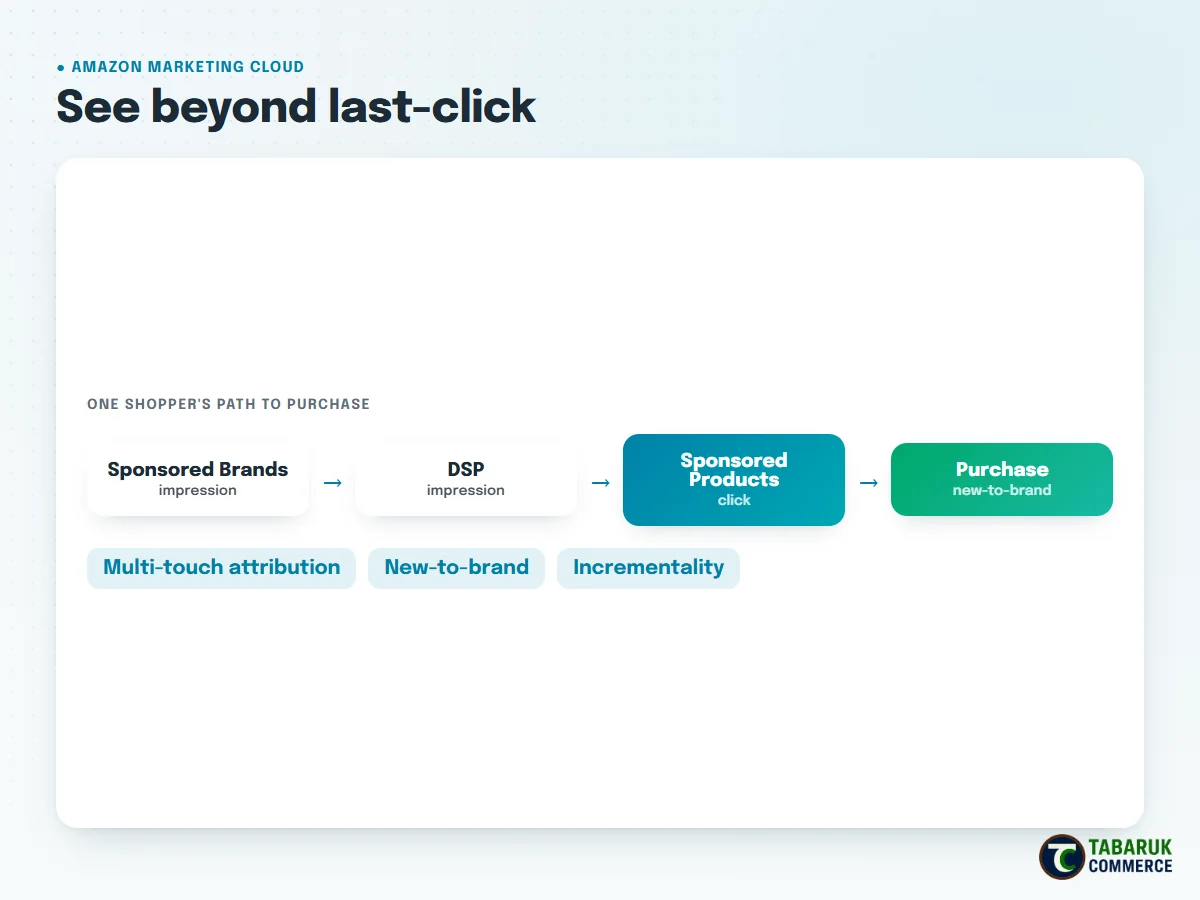
Last-click reporting gives almost all the credit to Sponsored Products, because that’s usually the final ad before a purchase. Path-to-purchase analysis often shows a different story: shoppers who saw a Sponsored Brands or Sponsored Display ad earlier convert at a different rate than those who only saw one ad type. That changes how you judge upper-funnel campaigns. This is multi-touch attribution in practice: credit shared across the ads that actually built the sale.
I’ve seen brands evaluate upper-funnel spend with lower-funnel expectations. Path to purchase is how you stop doing that.
2. New-to-brand analysis
The question: which ads bring in customers who have never bought from you before?
A campaign with a higher ACoS can still be your best growth campaign if it’s the one introducing new customers. New-to-brand analysis separates campaigns that grow the brand from campaigns that mostly capture shoppers who would have bought anyway.
3. Time to conversion
The question: how long do shoppers take from first ad to purchase?
If your category has a longer consideration window, judging a campaign on short-term results can make good ads look bad. Knowing your real time to conversion helps you set fair evaluation windows, pace budgets and read performance changes correctly.
4. Brand halo
The question: when you advertise one product, what else from your brand do shoppers buy?
Some ads sell more of your catalog than the product they promote. Halo analysis shows those spillover purchases, which campaign reports usually undervalue. It’s especially useful for deciding which ASINs deserve to lead your advertising.
5. Audiences
The question: who should we reach next, and who should we stop paying to reach?
Insights are only half the value. AMC also lets you build custom audiences from what you learn, such as shoppers who engaged with your ads but didn’t buy, or past customers ready for a repeat purchase, and activate them in your campaigns where supported.
What AMC won’t do for you
AMC is powerful, but it’s not magic.
- It needs volume. Because results are aggregated and small groups are hidden, low-spend accounts may not get meaningful answers yet.
- It needs the right questions. Running every template produces reports, not decisions.
- It doesn’t fix the basics. If the listing doesn’t convert or the keywords are wrong, AMC will just explain the problem in more detail.
When ACoS moves, AMC is how you find out what moved upstream.
Where DSP fits in
We see Amazon DSP as the next stage after PPC, for established brands with the capacity to invest in reaching shoppers beyond search. When you get there, AMC is what makes DSP measurable: it connects display and video exposure to the same purchase paths you already track for Sponsored Ads. Learn more about our Amazon DSP management.
Amazon Marketing Cloud FAQs
What does AMC stand for in Amazon Ads?
AMC stands for Amazon Marketing Cloud, Amazon’s clean room for analyzing advertising performance across campaigns and ad types.
Is Amazon Marketing Cloud free?
The core AMC product is available to eligible advertisers without an extra fee. Some advanced datasets and features are offered as paid add-ons.
Do I need DSP to use Amazon Marketing Cloud?
No. Amazon has opened AMC to Sponsored Ads advertisers as well as DSP advertisers. Eligibility can vary by account and marketplace.
Is Amazon Marketing Cloud a data clean room?
Yes. AMC is a privacy-safe clean room: you work with pseudonymized, event-level signals, and results are only returned as aggregated reports.
Do I need to know SQL to use AMC?
It helps for custom analysis, but you don’t have to start there. Amazon provides templates and instructional queries for common questions like path to purchase and new-to-brand.
Want to know what your ads are really doing?
We use Amazon Marketing Cloud inside our Amazon PPC management to judge campaigns on what they actually contribute, not just the last click. If you’d like a second opinion on your advertising, request a free Amazon account audit.

Mudassir Fayyaz is the founder of Tabaruk Commerce and an Amazon growth strategist. He manages 1P and 3P Amazon accounts across the US, Canada, UK, Germany, UAE, and Australia, with a focus on turning ad spend into net profit. Connect on LinkedIn.